Wedding Seating Chart with Divorced Parents
Seat divorced parents at different tables the same distance from you, give each their own people around them, and decide the hard cases before anyone else. Here is how, with a real 120-guest example.
Most seating charts are easy until they are not. One table with both of your parents and their new partners can sour a whole evening, and the guests at that table know it before the salad arrives. The good news: a few clear rules solve almost every version of this problem.
How do you seat divorced parents at a wedding?
Put each parent at their own table, as close to you as the other, with the people they are most comfortable with. Nobody gets the "lesser" table, and nobody has to make small talk with an ex for three hours.
- Two hosting tables. Mom's table holds her partner, her siblings and her closest friends. Dad's table holds his partner and his side.
- Mirror tables. Place the two tables either side of the dance floor at the same distance from your table. Guests notice when one parent sits by the kitchen door.
- Not next to each other. If things are tense, ask for tables that are not neighbours, not just different tables.
- A sweetheart table. A table for just the two of you removes the question of which parent sits with you. More in our guide to the sweetheart table.
What about remarried parents and step-parents?
Seat each parent with their current partner. It is their family now, and splitting a couple to "balance" a table creates a new problem. If a step-parent is close to you, give them the same treatment as a parent: a good table, near you, with people they know.
The rule that most often gets missed is the one between a parent and the other parent's new partner. In our sample wedding the bride wrote: "Mom and Tina cannot be at the same table." Tina is her father's wife. That is a keep-apart rule between Karen and Tina, even though Karen and Richard themselves would manage.
Feuding relatives, exes and grandparents
The same three tools work for every hard case: keep apart, keep the tables apart, and seat the vulnerable guest first.
| Situation | Rule |
|---|---|
| Two brothers who have not spoken in years | Different tables, and tables not next to each other. Opposite sides of the dance floor is ideal. |
| Divorced grandparents, one with a new partner | Keep the grandparent apart from the ex and the new partner. The new couple can sit together. |
| A friend and their ex both invited | Different tables. If they share a friend group, split the group between two tables so neither sits alone. |
| A grandparent in a wheelchair | The table closest to the door, the aisle seat, and the relative who helps them right beside them. |
| A guest who speaks little English | Seat them next to the relative who translates, at a table with their own family. |
A worked example: 120 guests, 12 rules
Our sample wedding is made up, but each of its problems came from couples describing their own families. Maya's parents are divorced and remarried. Her paternal grandparents are divorced too, and Grandpa Walt is bringing his partner. Daniel's father and uncle have not spoken in five years. Grandma Lupe uses a wheelchair and speaks mostly Spanish. A bridesmaid's friend and a groomsman dated last year. Ten children are under 12, and one has a nut allergy.
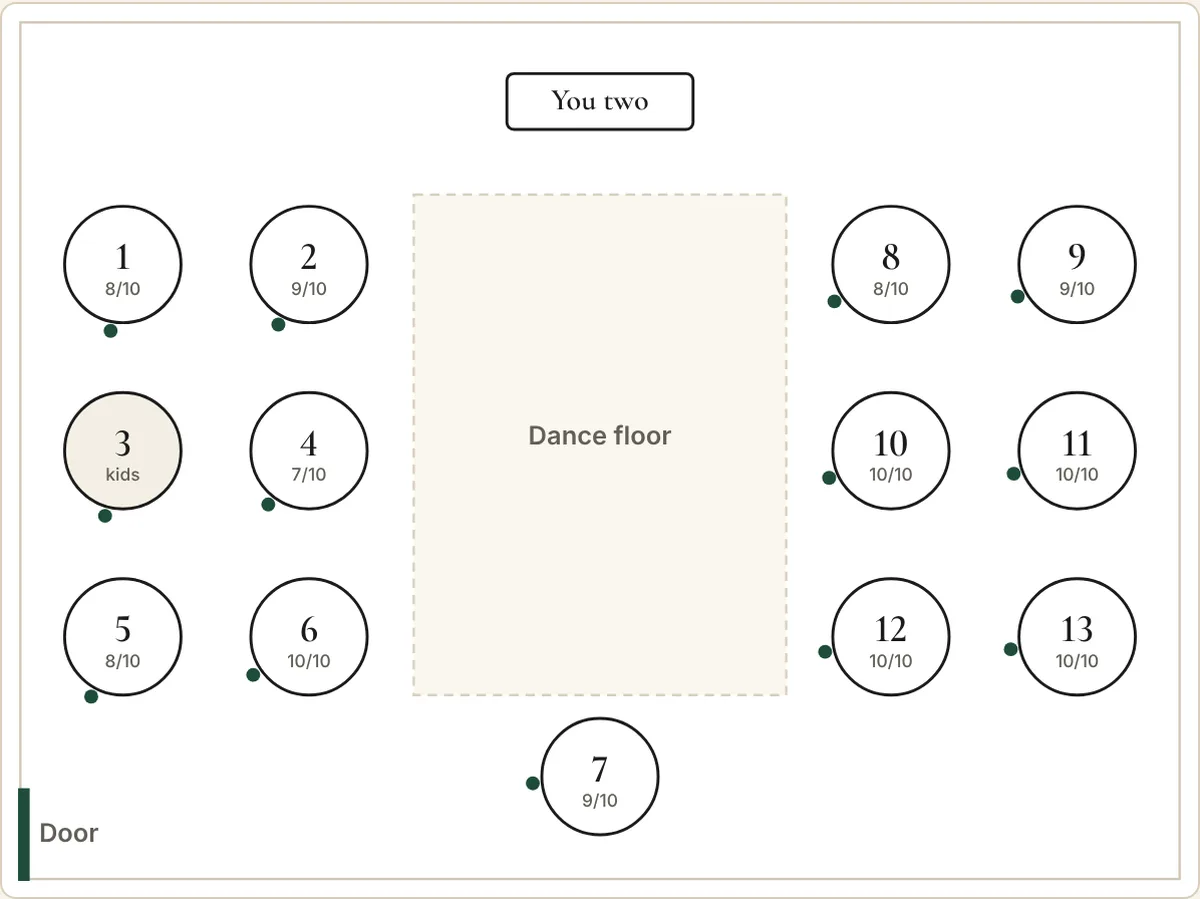
The bride wrote one paragraph about all of this. Our wedding seating chart maker turned it into 12 rules, each shown with the words it came from, and seated all 120 guests at 13 round tables with every rule met:
- Karen and Tina at different tables, on opposite sides of the dance floor.
- Karen's and Richard's tables mirror each other, the same distance from the couple.
- Grandma June at her daughter's table, away from Walt and Lorraine.
- Miguel and his brother Héctor across the room from each other.
- Lupe in seat 1 at the table closest to the door, with Tía Rosa beside her.
- The kids at one table near their parents, with the nut allergy on the caterer sheet and the place card.
Tell your coordinator who to keep apart
A planner keeps the family politics in their head on the day. If you do not have one, write it down for whoever runs the room. Our day-of brief lists every rule with the table and seat of each guest, so if someone asks to swap seats at the last minute, the coordinator can check before saying yes.
Do you have to tell anyone about the rules?
No. Guests see a seating sign and a card with their table number. The rules stay between you, your partner and your coordinator. That is the point: done well, nobody notices the seating at all.
Ready to seat your own guests?
Make your seating chart