Place Card Template: Tent Cards with Meals
A place card marks one guest's seat. A tent card that folds in half stands on its own, and a small meal mark on it tells the server what to bring without asking.
Do you need place cards at a wedding?
You need them when you assign seats, not only tables, and almost always for a plated dinner where guests chose their meal in advance. For a buffet with tables assigned by a seating sign or escort cards, you can skip them.
Tent or flat?
A tent card folds in half and stands up, with the name facing the guest. A flat card lies on the plate or napkin. Tent cards are easier to read from across the table and for the server walking behind the chairs. Flat cards suit a minimal table.
What goes on a place card?
- The name, large and clear.
- The meal, in small type, for a plated dinner. Some couples use a coloured dot or an icon instead. A word is harder to misread.
- An allergy note if the guest has one, so the server sees it at the seat.
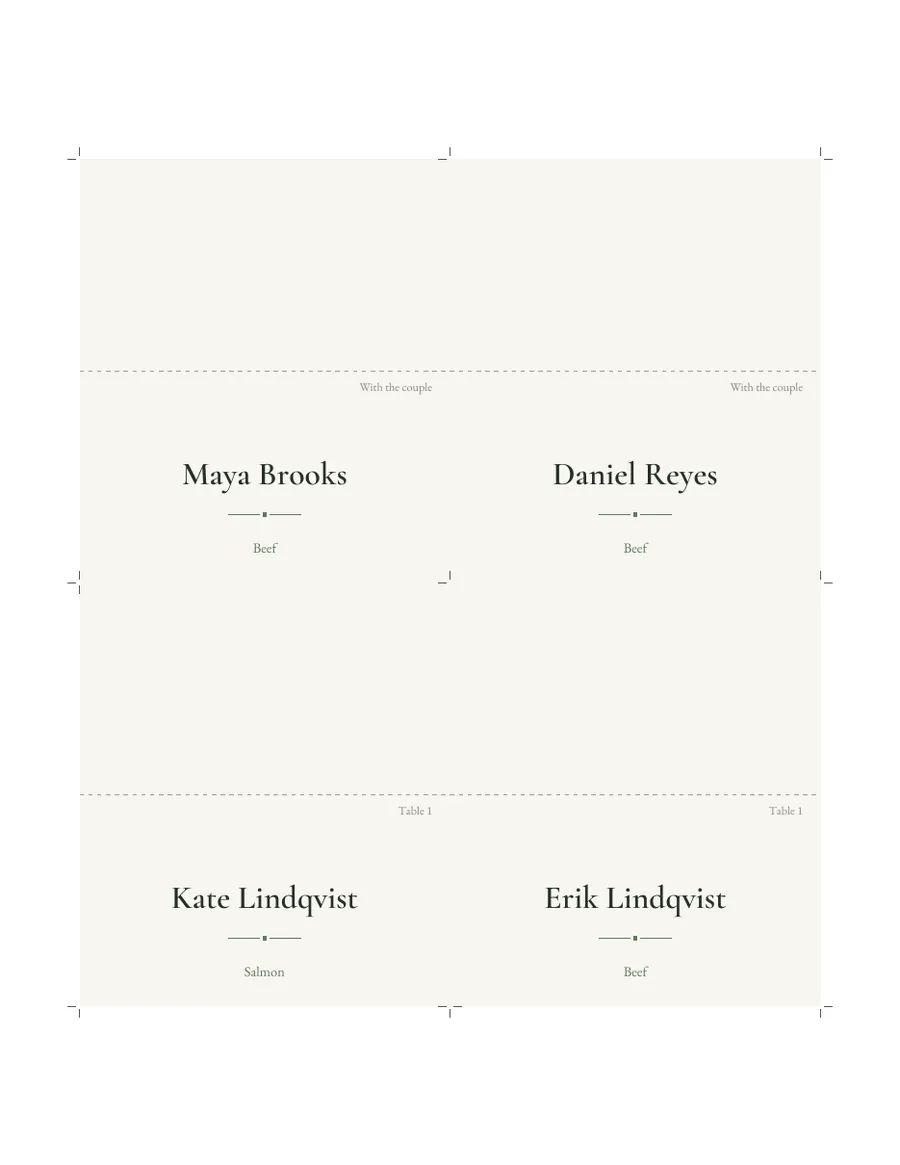
Our place cards print the guest's name on the front and the meal and any allergy flag underneath, from the same list as the caterer sheet. A test checks that the meal on every card matches the meal on the caterer sheet, so the card and the kitchen never disagree.
Which sheets fit?
Our tent cards print 4 to a US Letter sheet. Each card is 3.5 x 4 in flat and folds to 3.5 x 2 in, the size of Avery 5302 small tent cards. On plain card stock, cut on the corner marks and fold on the dotted line. On A4 the same cards sit centred on the sheet.
How do you put place cards out?
Table by table, seat by seat. Our cards print in seat order, and the caterer sheet in the day-of brief says which seat is seat 1 (the one nearest the door) and that seats go clockwise from there. Give the person setting tables both, and they can place 120 cards without a single question.
Meal codes the server can read in a second
A word is the clearest mark: "Beef", "Fish", "Vegetarian". If your design needs something smaller, use one letter per meal and give the caterer the key. Our caterer sheet prints the same key at the top ("B = Beef, S = Salmon, V = Vegetarian"), and the place card prints the full word in small type, so nobody has to remember a code.
For children, use "Kids" as the meal and the kids table number. For guests who chose nothing, leave the meal off rather than guessing; the caterer sheet lists them as "No meal chosen" so the kitchen can ask.
Place cards and allergies
An allergy belongs in three places: the caterer sheet, the place card and the watch list for the coordinator. On the card, keep it short ("Nut allergy") and in the same colour as the meal mark. Write it on the guest's card only, never as a table sign: it is personal, and the server needs it at the seat, not at the table.
Common mistakes
- Printing before the RSVPs are final. Wait until the caterer needs the final count.
- Names that only the couple use. Write the name the guest uses for themselves.
- Different spellings on the escort card and the place card. One guest list for everything prevents it.
Make cards that match your chart in the wedding seating chart maker.
Ready to seat your own guests?
Make your seating chart